Posts

Showing posts with the label twin souls

INTRODUCTION by Xavier Perez-Pons
Image
ANNOUNCEMENT AND DISCLAIMER On a spring afternoon in the year two thousand, I happened to wander into a bookshop in the old Barri Gòtic in Barcelona. The owner was busy taking books from two large wooden boxes. I was curious, so I asked him if I could have a look. The books were in Catalan, Spanish, French, and English, some of them illustrated, most of them filled with underlinings and pencil notes on the margin; there were also a couple in Portuguese and some other in Italian. They were of all sorts of literary genres, although I could spot a common subject. I asked the owner where he had gotten these boxes. They had belonged to a man that had recently died; that is all he knew. He had bought them at an auction, along with other private libraries and lots from all over the place. I asked him to give me a price, and I took the whole lot home. Actually, that is not true. There was more to the lot than those two boxes. There was a third one. A third box, which...
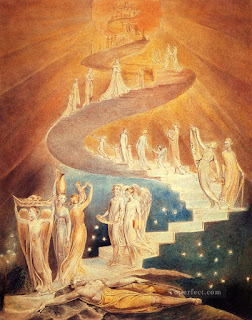
ENGLISH ROMANTICS

Image
(Quoted from the book:) The English Romantic William Blake, painter, engraver and mystic poet, also imagined the twin souls’ final reunion in God. Blake has many points in common with that other famous mystic, Swedenborg, by whom he was influenced. Their most remarkable common trait is their visionary gift, although, in this aspect, Blake was more precocious than our friend Swedenborg, since his visions seem to date back to his early childhood (he saw some angels perched on a tree while he was strolling around London with his father, who severely admonished him for telling lies!). These visions accompanied him throughout his entire life. They greatly inspired his work, Blanca, as the following anecdote, told by one of his disciples, will attest: this disciple was going through a time of creative crisis and, one day, visiting Blake’s house, he started to complain about it. Blake patiently listened to him, and then he turned to his wife Katherine and said, “The same thing happens to us...

LOVE FROM AFAR

Image
“Amor de lonh” (Love from afar) is the name by which the troubadour of the 12th century Jaufre Rudel, Prince of Blaye, named his beloved. I just quote from LOVE LETTERS FROM A WIDOWER: THE MYSTERY OF SOUL MATES IN LIGHT OF ANCIENT WISDOM: “Rudel is being killed by nostalgia for a woman he has never seen. But he ends up putting a face to this woman: she is the Countess of Tripoli, whom he recognises as his twin soul on account of the stories he hears from trav ellers returning from the Holy Land (Tripoli was one of the areas conquered by the crusaders). He even becomes a crusader himself just so he can go see her. However, during the trip, he falls ill and arrives at Tripoli on the verge of death. When the Countess learns of his presence, she rushes to be at his side, and so he dies in her arms, thanking God for allowing him to see her” https://www.amazon.com/Love-letters-widower-mystery-ancient-ebook/dp/B07CMG3HY3

THE SCENARIO

Image
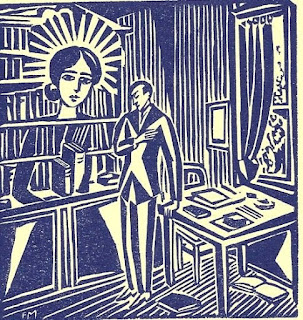
This engraving seems to evoke the scenario in which the Letters were written. Its author, momentarily leaving his writing work, searches among the books of the blue library for any sign of his deceased wife. (Engraving by Frans Masereel, 1920) https://www.amazon.com/Love-letters-widower-mystery-ancient-ebook/dp/B07CMG3HY3/ref=sr_1_1?s=books&ie=UTF8&qid=1546874346&sr=1-1&keywords=Love+letters+from+a+widower

LOVE AT FIRST SIGHT

Image
Quoted from the book: (Love at first sight) Out of all the examples I know, the loveliest one, in my opinion, was imagined by the English writer D.H. Lawrence in his novel-saga The Rainbow... Tom Brangwen was returning from Nottingham, one day, to his home in Cossethay with the cart packed with sacks of seed. He was walking alongside the horse when he saw a woman on the road, coming his way... "She had heard the cart, and looked up. Her face was pale and clear, she had thick dark eyebrows and a wi de mouth, curiously held. He saw her face clearly, as if by a light in the air. He saw her face so distinctly, that he ceased to coil on himself, and was suspended. 'That's her', he said involuntarily.../.... The feeling that they had exchanged recognition possessed him like a madness, like a torment. How could he be sure, what confirmation had he? The doubt was like a sense of infinite space, a nothingness, annihilating. He kept within his breast the will to s...

THE WOMAN/MAN OF HIS/HER DREAMS

Image
(Quoted from the book:) "I was telling you that perfume, or that concavity in bed, is like the 'ghost' of an absent person. Well, Jung calls this ghost of a woman present in the soul of every man 'anima'; 'animus' is the ghost of a man present in every woman. In light of the theory of the twin souls, the anima or the animus would be the reminiscence, the remains left in the soul by the spouse from the Origin as a result of its departure. This 'ghost' can appear in our dreams,   Blanca; the expression 'the woman –or the man- of my dreams' would be an allusion to it. Because dreams, my dear (as you may very well know; it has not been long since you slipped into one of mine), are not necessarily the usual banal and inconsequential dreams that serve as an outlet for the worries of waking life. When one pays close attention, dreams can become windows with a view to the backyard of reality, of hidden reality… In his medical practice as a psycholog...

THE GARDEN OF LOVE

Image
(Quoted from the book:) "The ancient sages conceived the cosmic mandala’s inner circle, Blanca, the inner essence or Centre of the Universe, as an intrinsically dual Unit. There is a medieval novel about which you might have heard –the Romance of the Rose- that regales us with a beautiful illustration of this subject. It tells us about a young man interested in initiating himself in the mysteries of Love –which are also those of the Universe. One night, this young man dreams t hat he is walking down a road that ends before a wall. He knows he must pass to the other side of this wall, but in order to locate the door, he finds himself having to go all around its border. What is on the other side? On the other side of this circular wall, the dreamer finds a secret garden –the “Garden of Love” from medieval and renaissance iconography-, where, in the centre, a circular fountain stands. And the dream continues until it reveals that this fountain contains two pristine crystals, on which...

TO DIE OF LOVE

Image
(Quoted from the book:) Talking about the Arabic ideal of chastity, Blanca, is talking about Udhra love, which is how courtly love is known in the Arab world. The name comes from a tribe who flourished between the seventh and eighth century in the Southeast of the Arabian Peninsula, in a remote valley in Yemen. The Bedouin tribe of the Banu Udhra, the “Sons of Virginity”, produced many poets; with the peculiarity that Udhra poetry is monothematic: it deals with one single issu e, spiritual love. But, in addition, the Udhra poets practiced what they preached: they became famous for cultivating the type of love they put into verse; a pure and chaste love, so intense (its intensity came from its purity) that it was said they “died of love”. The Arabic chronicles of the time tell about Udhras dying of no particular infirmity, but of love towards their lady. Otherwise, my dear, Udhra love verged on mysticism, on religion, to the point that orthodox Muslims denigrated and accused it of inter...

WORLDLY MARRIAGES

Image
(Quoted from the book: ) If you allow me, dear, I would like to tell you now -since I expounded on worldly marriage and its Heavenly model- a few words about divorce... We were talking before about the Early Church Fathers. About how some of them interpreted worldly marriage as a restoration of the true marriage, the one which had taken place in Heaven, under divine auspices. These Christian sages supposed that worldly marriages would be infallible, in the sense that they woul d reunite the original spouses. Hence, they considered divorce inadmissible. They did not count on the mistakes one would predictably make when recognising their predestined spouse among the crowd of potential candidates. John Milton, the great English poet, coming after Shakespeare and Donne, did count on those factors, Blanca. This led to the curious incident where if some Early Church Fathers put forward the concept of love predestination as an argument against divorce, Milton, in the seventeenth century, did ...

THE EYES OF THE HEART

Image
(Quoted from the book:) The benefits of looking with the eyes of the heart rather than the physical eyes, Blanca, is, as you know, one of the most repeated messages in fairy tales. It’s also the central message of that modern fairy tale, The Little Prince. What’s more, many stories echo Cinderella's plot, that of the lost and recovered Paradise, with the prince and princess' mutual search, the obstacles and challenges they must overcome before finally uniting (a union that is   usually a reunion) and their wedding at the end. Here abides, as I was telling you, the same subconscious and nostalgic memory of the Origin that gave rise to the universal myth of the Androgyne. But in the story of Cinderella, there is yet another collateral theme also present in countless other fairy tales: superficial ugliness, the ugliness that enshrouds a great beauty. The Little Prince https://www.amazon.com/Love-letters-widower-mystery-ancient-ebook/dp/B07CMG3HY3

THE PREDESTINATION OF LOVE

Image
(Quoted from the book:) “By heavenly chance express”, Blanca. Meaning that encounter, while coincidental in appearance, was actually arranged. Heaven scheduled an appointment, so to say, and put them both in that place at that exact time so they could meet. You know, the last two verses also make me think about your beauty. Because before and after that afternoon – the one we met -, I had seen   women who were more beautiful than you. Yet, it’s strange; none of them looked so to me. Those two verses - “Unveils to him that loveliness / Which others cannot understand” - suggest an idea that I posit as the starting point to these letters: the idea that beyond objective beauty exists a subjective hidden beauty; a mysterious beauty that reveals itself only to its predestined eyes. (One must not confuse this subjective beauty with the set of spiritual qualities a person might possess, qualities we call “inner beauty”: while inner beauty, my dear, is certainly superior to outer beauty, it...

JOHN DONNE & ANNE MORE

Image
(Quoted from the book:) The poems from his youth show us a womanising Donne. However, later in life, Donne changed. And do you know what the scholastics think was the turning point for this change? He found his twin soul: Anne More, a young lady whose aunt was married to a high-ranking court member where Donne was a secretary (this was the trick Destiny devised to bring them together). It seems like from the moment they met, they knew they were made for one another. And what  happened was that the amorous cynicism that he had shown until then, gave way to an increasingly higher and deeper conception of love. A conception that was intertwined with the idea of God, Blanca, as evidenced by the proliferation of religious references in his later works… In one of those poems, Donne warns Anne More about the likely event of one of them dying before the other. There is no need for despair, he tells her, because it will not be an actual separation: it will be like when spouses turn around i...

ANDRE BRETON & ELISA CLARO

Image
(Quoted from the book:) The last personal testimony we will visit before returning to the bountiful fields of literary fiction is by a modern poet of “ancient perspective”. It’s not by chance, my love, that this poet born at the turn of century, the French André Bréton, was a key figure of Surrealism, a movement that called for the primordial role of intuition in art in general, and in poetry in particular. Having studied esoteric tradition in depth, Bréton was a profound conn oisseur of ancient knowledge. Well, then, it’s in the autobiographical Arcane 17, where he writes to his beloved Elisa, with whom he married almost immediately after meeting: “Before I met you, but what am I saying, these words make no sense. You know that the first time I saw you, there is no doubt I recognised you.” This, Blanca, is love at first sight, what in French is known as coup de foudre, “thunderbolt”. That is to say, a sudden love that sweeps you off your feet, which Bréton himself baptised as amour fo...

PARACELSUS

Image
(Quoted from the book:) The belief in the predestination of love had many supporters in ancient times. It explained a phenomenon that is otherwise quite difficult to explain. A phenomenon we could articulate in the following manner: “There are secret links of affection, that no reason can be rendered of.” This quote comes from an essay on matrimony written by a representative of seventeenth century Protestant Puritanism, the Englishman Thomas Gataker. Six hundred years before,  a distinguished Andalusian poet and philosopher called Ibn Hazm of Cordoba, had expressed the same thing with these words: “If the cause of Love were physical beauty, the consequence would be that nobody defective in any shape or form would attract admiration; yet we know of many a man actually preferring the inferior article, though well aware that another is superior, and quite unable to turn his heart away from it. Again, if Love were due to a harmony of characters, no man would love a person who was not ...

DEAR BLANCA:

Image
Today we would celebrate... Correction; today we celebrate fifty years of marriage. Our golden anniversary. To celebrate it, I took my pen (your pen, the one you gave me) and started writing to you. First, I want to apologise for not having done this before. Or, to be fair, for not being able to continue beyond the first line, because the fact is I tried, co untless times, without success. It wasn’t because I didn't have anything to say to you. It just so happens that sorrow is a great obstacle for words; it stops them from flowing out of your mouth or pen. Even the more pressing ones. One's life could be in grave danger, and it would still be a superhuman effort just to ask for help. This could h sound like an excuse, but believe me: it’s not an excuse, it’s a good reason. Anyway, since this time I was able to go beyond the cursed threshold of the first line, you can deduce that I have found some consolation to my sorrow. And it's precisely about that, my love, about the f...

KABBALISTS

Image
(Quoted from the book:) You remember that sentence from the Zohar relating to the conjugal union: God will not establish His residence in a place where such union does not exist. That being the case, and from the moment that God had established His residence in the Ark of the Covenant, the conjugal union had to manifest itself on the Ark. The two Cherubim represented, then, the divine Spouses. The Scripture says that they contemplated the sacred Ark, but also each other, “the ir faces one to another; toward the mercy seat shall the faces of the cherubim be” (Exodus 25:20). The tradition of depicting God and His Wife face to face, looking into each other’s eyes, came from Antiquity, dated back to the pagan religions, as archaeological findings can attest. In fact, Blanca, it’s the posture in which spouses, and lovers in general, have always been portrayed (remember the heavenly couple described by Swedenborg, of how they extracted their Beauty from mutual contemplation), and it denotes ...

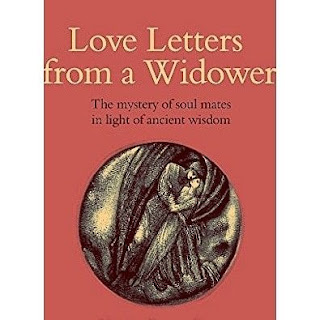
"LOVE LETTERS FROM A WIDOWER: THE MYSTERY OF SOUL MATES IN LIGHT OF ANCIENT MYSTERY"

Image
“Theologians maintain that the mere presence of a feeling of God in Man’s heart, is, in itself, a proof of His existence. Since –as they assure us- that feeling is innate, it’s actually a reminiscence. Well, if it’s as they say, Blanca, then, along with a feeling of God (and, as I hope to demonstrate during the course of these letters, closely bound to it), there exists in Man’s heart another innate feeling of no less power. The feeling of the twin soul, of the one creature who, out of every other, is destined to us, for it’s the other half that will complete us.” Thus begins one of the letters of this epistolary essay in which the author undertakes an exhaustive tracing of the theory of soul mates in the history of Religion and Philosophy, of Literature and Occult Sciences, showing the preeminent place that in the worldview of the ancient sages occupied this enigmatic feeling that we know today as romantic love. https://www.amazon.com/Love-letters-widower-mystery-ancient-ebook/...